|
Few now know the story of the Hoovers and their "call and response to action" when World War I broke out in Europe on August 1914. As private citizens living in London they organized friends and distributed hundreds of thousands of dollars to help stranded Americans return home from across Europe when war was declared. With the help of other ex-pats contributing time and resources, their trust on nothing more than "a handshake and promise" saw all but a few hundred dollars repaid and an estimated 60,000 Americans assisted during this time. The organization they created was named "The American Relief Committee" (ARC), and with word spread by the American consulates all over Europe, Americans who could reach London were guaranteed "transport home" as well as care, comfort and clothing during the wait. (Learn more about those individuals who ranged from Wild West Showmen to the crankiest of grand-dames). It was a herculean effort by the Hoover's who led a small group of men and women to assist upwards of 60,000 Americans to leave the continent when banks were closed and money exchange (pre-Euro) was next to impossible. Lou Hoover provides great insight into both the life of her husband as well as her own activities during this time in a letter written to her parents on August 22, 1914: “Since August fifth we have been working. Got back from the country the night of the 3rd. We celebrated Herbert’s birthday the 4th at home. About 2:30 Bert telephoned to ask me for 100 pounds in money which I happened to have in the house, and said if I wanted to see an interesting sight to come down. Early in the day a few people whom Bert knew had turned up at his office for money. And later the consul, quite a new man, had telephoned to ask Bert’s advice and assistance because of the hundreds arriving there. So Bert took what money he could gather up about the office and my hundred pounds and some he could get from his friends and went over to the consulate and began lending out money (of course without interest) in small amounts to American tourists to live on a few days. He took care of over 300 that day. The shops were open but would take only cash and small checks of their own customers. The banks were all shut and most of the large and influential places were too. No one would take continental paper money, which most of them had, nor letter of credit nor continental nor American bank checks or drafts, nor American Express and similar check nor even American paper money! Of course any kind of gold was taken at its weight. But there wasn’t much of that. Most of the shops refused to take even English paper money if they had to make change in return! And of course there were all sorts of rumors as to boats being taken off and no possibility of getting home and nearly everybody was rather panicky. A tourist committee of some bankers and other active men had been formed the day before to see about getting transports from home, or doing something else to get themselves (and as many others as possible) home. They had met at the Savoy—a big hotel we knew very well. And Bert had been in to see them, and said there were lots of ladies arriving there for aid and sympathy. So I went down to the hotel before ten o’clock, saw the perfect pandemonium there, called half a dozen women I knew would keep their heads and could work, and offered to look after the women and children who had no men with them. They made me the woman member of the big men’s committee and since then I have worked day and night, and certainly left the boys to Amy! But none of us could think of just the right other person to do it instead of me. We made all sorts of arrangements whereby people could get money on their credits. Bert established a wonderful telegraphic money order system that started work immediately and produced the money in 24 to 48 hours—although the regular telegraph systems have not yet caught up with their work. When there was no other way of getting money we lent it to them. We got them boarding places, clothes (lots of them had lost even their suitcases), found their relatives for them and made arrangements for shipping them home when the boats began to move again. Nearly 40,000 of them have been sent home in the three weeks and it is estimated there are between 10,000 and 20,000 still here with a few hundred arriving from the continent every day. Well, altogether it has made a lot more work than it sounds in this letter. We have not even thought when we should start home. Of course both the boats we had passage on have been taken off.” Lou and her two sons returned home on the Lusitania leaving on October 3, 1914. Bert planned to return after settling matters as soon as possible. These plans changed when Millard Shaler, a fellow American Mining Engineer, requested Hoover's help in getting food to German occupied Belgium. With a lot of negotiations between adversaries, the plan resulted in the creation of the Commission for Relief in Belgium (CRB). The ARC was just the beginning to an even greater humanitarian effort, one of many in the coming years in Europe and the United States. Lou Henry Hoover letter cited June 30, 2021 by Thomas Schwartz, posted in hoover.blogs.archives.gov Read more ARC and CRB stories here: Get me Outta' Here! No Horses, No Tents, No Money
0 Comments
Planning a vist to Nancy, Luneville and (of course) Vitrimont, I wanted to visit Verdun for a day. From Nancy it's an easy 1 hour+ drive. Daisy wrote of the devastation in the northern part of the front and it is well worth a visit today.
However ... I needed a simple map. What I found were endless sites trying to sell me a map or a tour. Some sites had great info, but no directions or details showing order or access. There are busses and drivers aplenty if that's what you want. But if you want to tour at your own pace by bike, foot or car, I offer my self-guided do-it-yourself Verdun visit. I created a route and some basic info, knowing I had plenty of history to accompany me on site. My two adult sons had done some research, but the Verdun Memorial Museum was a perfect place to start. This is what I offer here. Ten must-see Verdun sites. I'll add further comments and maybe more sites later. But for now - here's a free map to help you navigate the memorials and battlefields of Verdun. Verdun Self Tour Map
An easy to follow free map for a day tour of the Verdun Battlefields, Memorials & Monuments
The Verdun map is numbered and has brief descriptions. Click on any blue marker to enlarge and see details about each site.
The 1916 Preparedness Parade. courtesy US Library of Congress
Over a century ago, tensions about the war in Europe, labor unrest and the Committee for Law and Order exploded. Quite literally on July 22, 1916, a suitcase bomb killed 10 and seriously injured 40, at the city’s “Preparedness Day” parade—one of the largest parades in the city’s history with 51,000 marchers participating. Everybody seemed to be there including Phoebe Hearst leading delegations of women down Market street. The bomb exploded at 2:06 at Market and Steuart Streets.
The idea behind a “preparedness” demonstration, which also took place in New York and Washington, D.C, was to support the American military in the event of the nation entering World War I - which we did one year later. But many were against this interference overseas, and labor leaders protested it was another get rich scheme for industrialists on the backs of working men. So after the mystery bomb blast left little evidence, the police and government was eager to find the criminals. Immediately socialists, anarchists and pro-labor organizers were targeted. Two labor activists, whom the papers referred to as "radicals", were convicted and jailed then released in 1939 after the police were accused of witness tampering in a mob scene trial. What do airplanes have to do with Daisy Polk? Living in Alsace-Lorraine on the Western Front during the war, and rebuilding Vitrimont after German bombings - she had first-hand experience with these planes, even writing about visiting the airbase near the forest of Parroy. She also knew a few fliers. One pilot married Ethel Mary Crocker and flew over the Vitrimont church on her wedding day "dropping" flowers for the bride and groom. More on this gentleman in a later post - for now if you're interested watch the short compilation of film below - Aéroplanes of the first world war - believe me your first bike had more metal parts!
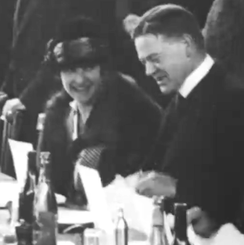
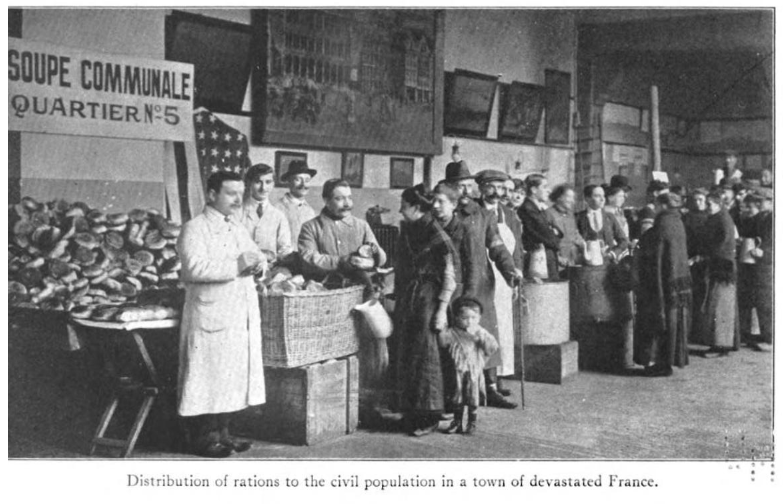
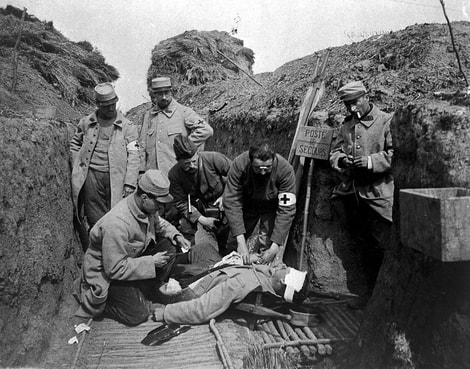
This rare war film footage from 1914 to 1917 records aviation before the US officially entered the war and highlights the planes in use with names reflecting early pioneers and designers in the industry (see more airplane WWI history and list click "Read More" below). Nothing is more fun than digging around the Internet and finding a research gem! This week there have been plenty. Today's find comes from the National Archives, a virtual treasure trove of fun. I was looking for footage of Nancy, Luneville and Vitrimont during World War I. Well I found it! And in a search for General DeBuyer I also found Daisy and Herbert Hoover visiting the Citroen Munitions Plant. She was referred to as Madame La General. So I found what I didn't know I was looking for ... film of Daisy! It's silent, so don't fiddle with your volume. It starts with an overview of the lunch break, then pans to show the VIP table of visitors at about 1:10. In 1919, Daisy and Ethel Mary Crocker helped organize Postes de Secours in 18 villages around Moislains, Arrondissement de Péronne, Somme, Hauts-de-France. They also founded and endowed a pouponierre (rough transaltion - childrens nursery/orphanage). Most of the Somme was occupied and devastated during the war, 1914 - 1918. These four years were even spoken of at times as “the crucifixion of Picardy”. Albert, Péronne and Montdidier were reduced to a pile of rubble. 28,000 hectares of land and 381 villages were included in the red zone, a zone that was considered to be uninhabitable, but as the villagers returned, provisional housing usually in the form of wooden or corrugated iron huts, quickly began to be built. The area was in great need at the end of the war. Learn more about the need and their work by clicking "Read More" |
Some stories that couldn't make the book in full ... but need to be told! Editors welcomed - sign up below.
STORIES
AAMERICAN RELIEF COMMITTEE (ARC) IWRC CROSSING BORDERS MOULIN ROUGE SACRE-COUER GENOA 1889 11.11.11 THE LITTLE CHURCH VITRIMONT SCRAPBOOK TOUR VERDUN WR HEARST PLANS SONG: DAISY HOT SPRINGS 1882 A WILLIS POLK GIFT THE RLS CONNECTION 1896 EARTHQUAKE TALES FROM COPPA PANDEMIC OF 1889 THE BOMB THAT SHOOK SF MILAN:CITY OF WATER POLK ON THE MAP FEATHERS, FASHION & FLY FISHING RARE AVIATION FILM - WWI 1914-17 1906 SAN FRANCISCO WTF FILES - TECHNOLOGICAL GET ME OUTTA HERE! NO HORSES, NO TENTS, NO $ DAISY IN FRENCH LITERATURE DAISY ON FILM! THE WHITE DEATH THE SYMBOLISM OF FLOWERS POSTE DE SECOURS WWI TRAVEL 1900: LONDON TO PARIS DAISY: REST IN PEACE KEITH'S, DRANE'S & KENTUCKY MOTHER: MISSOURI COMPROMISE Topics
All
|


RSS Feed